New Delhi: In a significant direction aimed at improving judicial infrastructure, the Supreme Court has observed that "lack of funds cannot be an excuse" for failing to provide basic sanitation facilities in courts across the country. The Court directed all States and Union Territories to ensure the availability of clean, functional, and accessible washrooms in every court complex.
A Bench of the Supreme Court noted that proper sanitation is a fundamental requirement for ensuring dignity and access to justice. The Court remarked that lawyers, litigants, judicial officers, court staff, witnesses, and members of the public spend long hours in court premises and should not be deprived of basic facilities such as hygienic toilets.
The Court emphasized that maintaining functional washrooms is not merely an administrative responsibility but an essential part of providing a fair and accessible justice delivery system. It stated that inadequate sanitation particularly affects women, senior citizens, children, and persons with disabilities, who often face significant hardship due to the absence of proper facilities.
Expressing dissatisfaction over reports highlighting poor infrastructure in several court complexes, the Bench directed all State Governments and Union Territories to work in coordination with the respective High Courts to identify courts lacking adequate sanitation facilities and take immediate corrective measures.
The Supreme Court also instructed authorities to ensure that washrooms are regularly cleaned, properly maintained, adequately supplied with water, and equipped with basic hygiene facilities. Wherever necessary, separate washrooms should be provided for men and women, along with accessible toilets for persons with disabilities.
The Bench made it clear that financial constraints cannot justify the denial of such essential facilities, observing that access to clean sanitation is closely linked to the constitutional values of dignity and equality. It stressed that governments must prioritize expenditure for basic judicial infrastructure.
The Court further directed the concerned authorities to submit compliance reports detailing the steps taken to improve sanitation facilities in court complexes. It indicated that the matter would remain under judicial scrutiny to ensure effective implementation of its directions.
The order is expected to improve infrastructure in courts across India by ensuring that every court complex provides safe, clean, and functional washrooms for all stakeholders involved in the justice delivery process.
Source : Trending Lawyers
Supreme Court
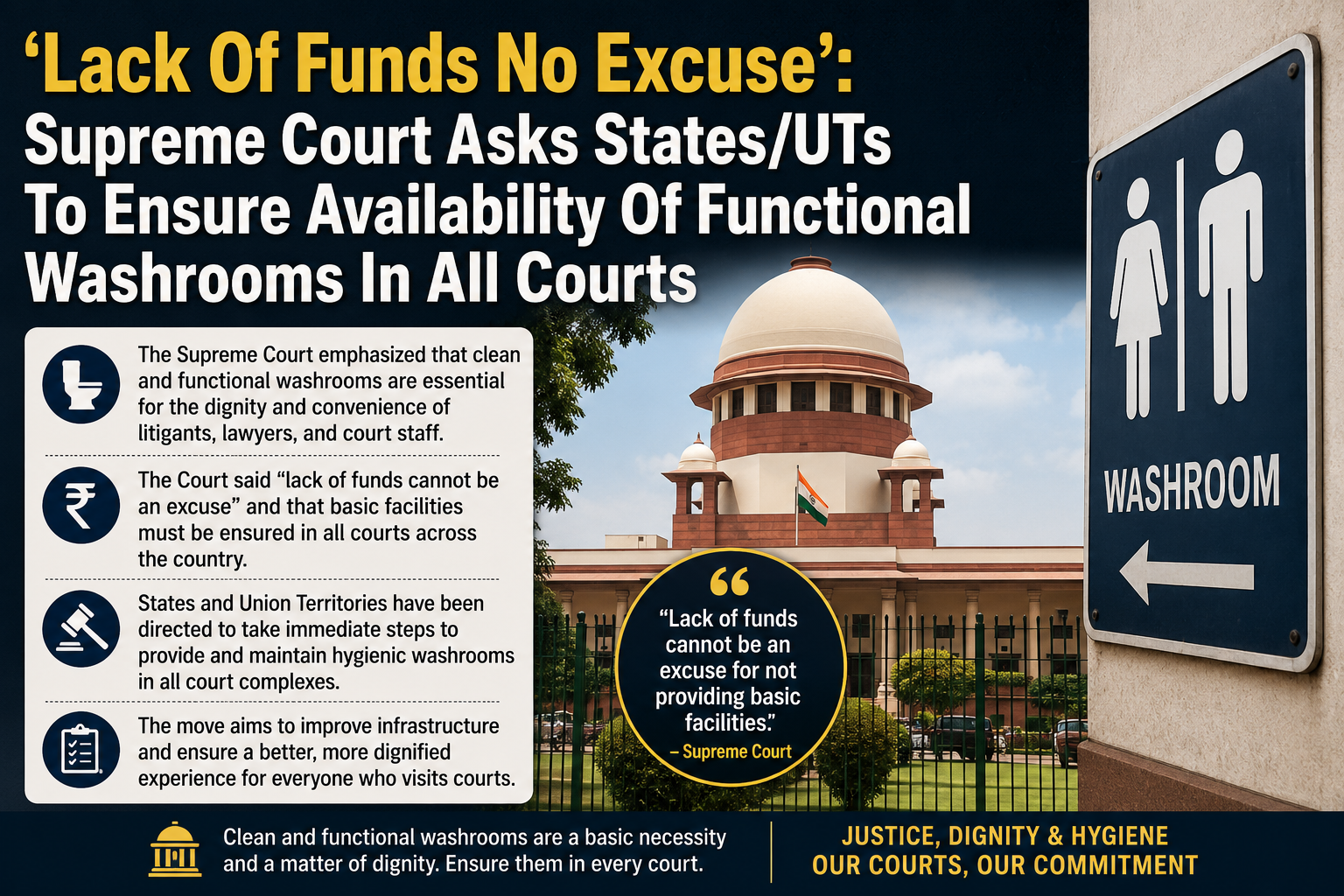
Lack Of Funds No Excuse': Supreme Court Asks States/UTs To Ensure Availability Of Functional Washrooms In All Courts
📅 17 July 2026
The Supreme Court has emphasized that lack of funds cannot be used as an excuse for failing to provide basic sanitation facilities in courts across the country. Stressing the importance of dignity, hygiene, and access to justice, the Court directed all States and Union Territories to ensure that every court complex has functional and well-maintained washrooms for litigants, lawyers, judicial officers, court staff, women, senior citizens, and persons with disabilities.
The Court observed that clean sanitation facilities are a fundamental requirement for a properly functioning judicial system and instructed authorities to take immediate steps to upgrade and maintain washrooms in all court premises. The matter will continue to be monitored to ensure compliance with the directions.
← Back to News
The Court observed that clean sanitation facilities are a fundamental requirement for a properly functioning judicial system and instructed authorities to take immediate steps to upgrade and maintain washrooms in all court premises. The matter will continue to be monitored to ensure compliance with the directions.