Arbitration | Article 227 Can't Be Invoked To Challenge Rejection Of Section 16 Application By Arbitral Tribunal: Supreme Court
New Delhi: In a significant ruling reinforcing the principle of minimal judicial intervention in arbitration proceedings, the Supreme Court has held that Article 227 of the Constitution cannot be invoked to challenge an arbitral tribunal's order rejecting an application under Section 16 of the Arbitration and Conciliation Act, 1996.
The Bench observed that the Arbitration and Conciliation Act is a self-contained legislation that provides a complete mechanism for resolving disputes arising out of arbitration proceedings. It emphasized that permitting parties to invoke the High Court's supervisory jurisdiction under Article 227 against every interlocutory order of an arbitral tribunal would defeat the very objective of the Act, which is to ensure speedy, efficient, and uninterrupted resolution of disputes through arbitration.
The Court clarified that Section 16 empowers an arbitral tribunal to rule on its own jurisdiction, including objections regarding the existence or validity of the arbitration agreement. If the tribunal rejects such an objection and decides that it has jurisdiction to proceed, the aggrieved party cannot immediately challenge that decision before the High Court under Article 227.
Instead, the party must continue with the arbitration proceedings and, if aggrieved by the final arbitral award, avail the statutory remedy provided under Section 34 of the Arbitration and Conciliation Act. The Court observed that entertaining petitions under Article 227 at an intermediate stage would unnecessarily delay arbitration and undermine the legislative intent behind the Act.
The judgment reiterates the settled legal position that courts should interfere with arbitration proceedings only in exceptional circumstances and only where expressly permitted by the Arbitration Act. The Supreme Court stressed that the constitutional power under Article 227 should not be used to bypass the specific remedies provided under the statute.
This decision is expected to strengthen India's pro-arbitration regime by limiting unnecessary judicial interference during ongoing arbitral proceedings and by encouraging parties to follow the dispute resolution framework established under the Arbitration and Conciliation Act, 1996.
Source: Trending lawyers
Supreme Court
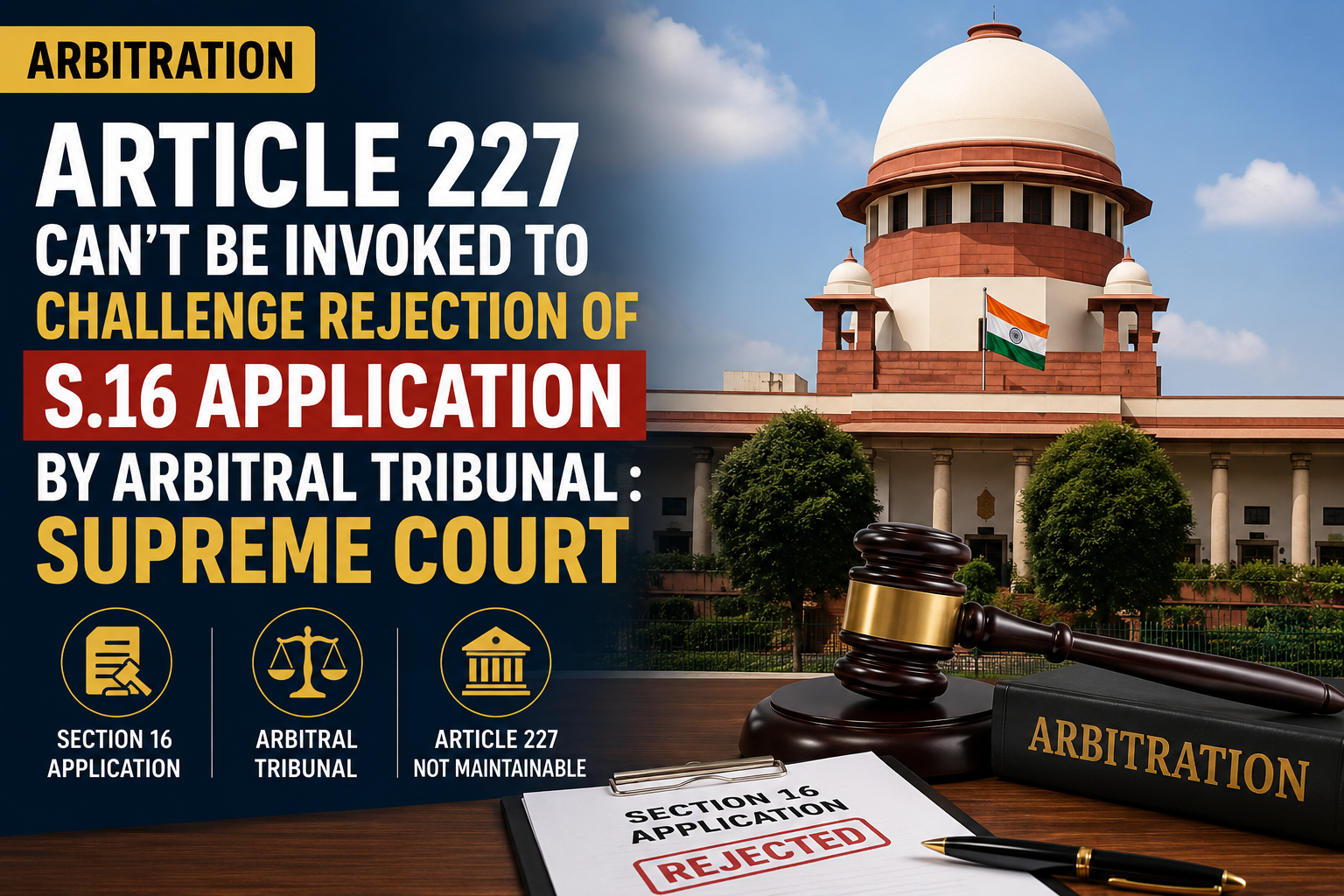
Arbitration | Article 227 Can't Be Invoked To Challenge Rejection Of S.16 Application By Arbitral Tribunal : Supreme Court
📅 15 July 2026
The Supreme Court has held that a party cannot invoke Article 227 of the Constitution to challenge an arbitral tribunal's order rejecting an application under Section 16 of the Arbitration and Conciliation Act, 1996. The Court ruled that the Arbitration Act provides a complete statutory framework for challenging such orders, and judicial interference under Article 227 at an intermediate stage would defeat the objective of speedy and efficient arbitration. Parties aggrieved by a Section 16 decision must follow the remedies prescribed under the Arbitration Act, rather than approaching the High Court under its supervisory jurisdiction. This judgment reinforces the principle of minimal judicial intervention in arbitration proceedings and strengthens India's pro-arbitration legal framework.
← Back to News