New Delhi: The Supreme Court has clarified that the Election Commission of India (ECI) does not possess the constitutional authority to determine the citizenship of individuals while preparing or revising electoral rolls. The observation came during the hearing of petitions concerning the Special Intensive Revision (SIR) of electoral rolls, where concerns were raised about the scope of the Election Commission's powers.
A Bench of the Supreme Court observed that the constitutional responsibility of the Election Commission is confined to conducting free and fair elections, preparing electoral rolls, supervising elections, and ensuring compliance with election laws. The Court emphasized that questions relating to citizenship fall within the jurisdiction of competent authorities established under the Citizenship Act and other applicable laws, and not the Election Commission.
During the proceedings, the Court noted that the inclusion or exclusion of a person's name from the electoral roll does not, by itself, determine the person's citizenship status. A person's omission from the voters' list may occur for several administrative or procedural reasons and cannot automatically lead to the conclusion that the individual is not an Indian citizen.
The Bench further clarified that while the Election Commission is empowered to verify voter eligibility in accordance with election laws, it cannot assume the role of deciding citizenship disputes. Such matters require adjudication by authorities specifically empowered under the legal framework governing citizenship.
The Court also observed that the constitutional mandate of the Election Commission is limited to the preparation, revision, maintenance, and supervision of electoral rolls. Expanding its authority to determine citizenship would go beyond the powers conferred upon it under the Constitution and the Representation of the People Act.
The hearing arose in the context of petitions challenging aspects of the Special Intensive Revision process, where apprehensions were expressed that exclusion from electoral rolls could unfairly affect individuals. The Court reassured that non-inclusion in the electoral roll should not be interpreted as a declaration that a person's citizenship is doubtful or invalid.
Emphasizing the importance of constitutional boundaries, the Supreme Court reiterated that every constitutional authority must function within the limits of its legally assigned powers. The Court stated that the Election Commission's role is to ensure the integrity of the electoral process, while citizenship-related issues must be resolved by the competent statutory authorities following due process of law.
The matter remains under consideration before the Supreme Court, and the Court's observations reinforce the distinction between voter eligibility and citizenship determination, ensuring that constitutional powers are exercised only by the authorities empowered to do so under law.
Source: Trending Lawyers
Supreme Court
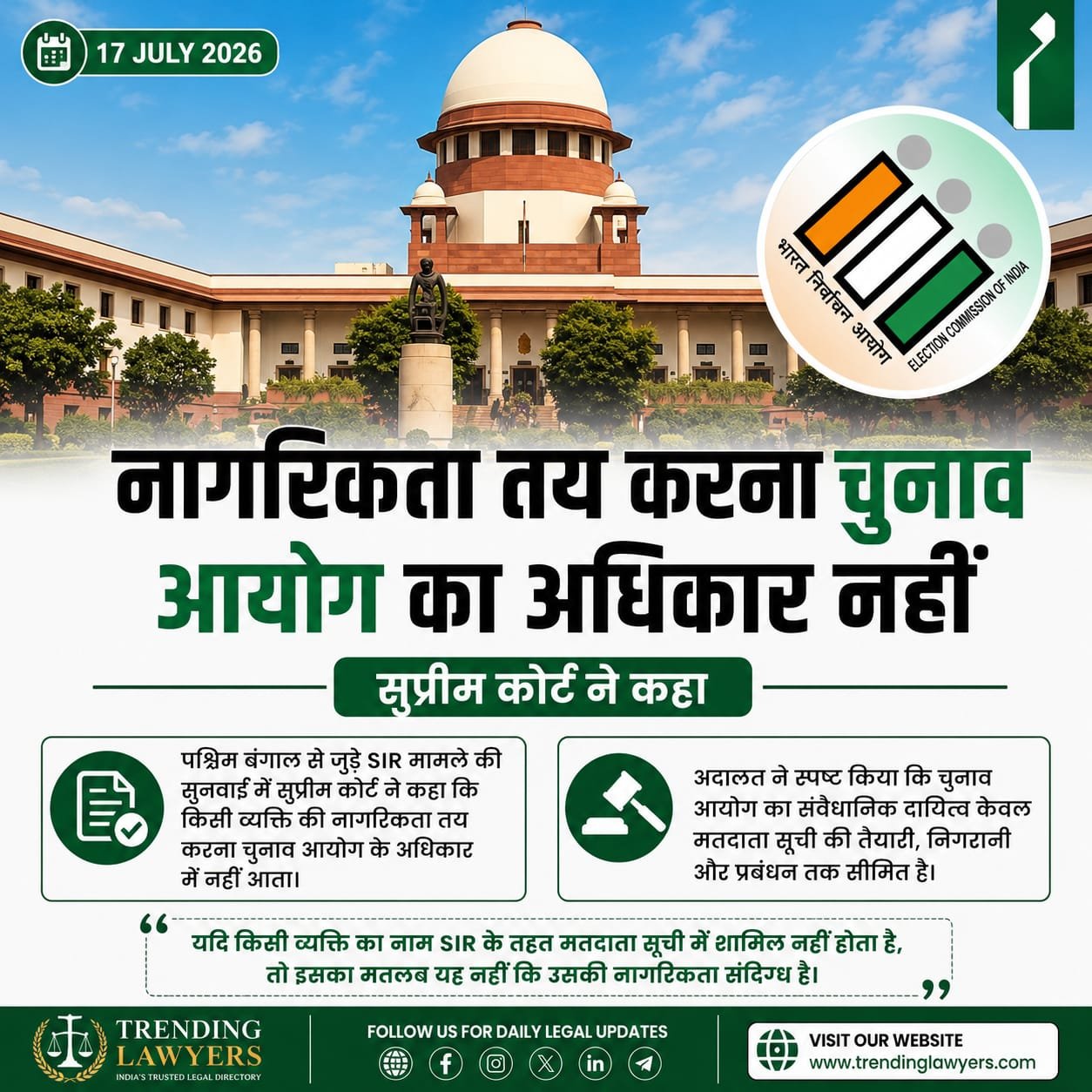
The Supreme Court has clarified that the Election Commission of India (ECI) does not have the authority to determine the citizenship of any individual.
📅 19 July 2026
The Supreme Court has clarified that the Election Commission of India (ECI) does not have the authority to determine the citizenship of any individual. During the hearing of petitions relating to the Special Intensive Revision (SIR) of electoral rolls in West Bengal, the Court observed that the constitutional role of the Election Commission is limited to the preparation, revision, supervision, and management of electoral rolls and elections, and not to deciding questions of citizenship.
The Court further noted that non-inclusion of a person's name in the electoral roll during the SIR process does not automatically mean that the person is not an Indian citizen or that their citizenship is doubtful. Questions relating to citizenship can only be determined by the competent authority under the applicable laws.
The observations reinforce the distinction between voter eligibility and citizenship status, emphasizing that the Election Commission cannot assume powers beyond those granted to it under the Constitution and election laws.
← Back to News
The Court further noted that non-inclusion of a person's name in the electoral roll during the SIR process does not automatically mean that the person is not an Indian citizen or that their citizenship is doubtful. Questions relating to citizenship can only be determined by the competent authority under the applicable laws.
The observations reinforce the distinction between voter eligibility and citizenship status, emphasizing that the Election Commission cannot assume powers beyond those granted to it under the Constitution and election laws.