Chennai: In an important judgment reinforcing the constitutional right to peaceful protest, the Madras High Court quashed a criminal case registered against a farmer who had staged a hunger strike to highlight his grievances. The Court observed that peaceful protest is a hallmark of democracy and citizens cannot be prosecuted merely for expressing dissent through lawful means.
The case arose after the farmer organized a peaceful hunger strike to draw the attention of authorities towards issues affecting him. Following the protest, the local police registered a criminal case alleging violations under various provisions of law. Challenging the FIR, the farmer approached the Madras High Court, arguing that his protest was peaceful, non-violent, and protected under the Constitution.
After examining the records, the High Court noted that the protest did not involve violence, damage to public property, or any threat to law and order. The Bench observed that the allegations contained in the FIR did not disclose the commission of any cognizable offence and that the prosecution lacked a legal foundation.
The Court emphasized that Article 19(1)(a) and Article 19(1)(b) of the Constitution guarantee every citizen the right to freedom of speech and expression and the right to assemble peacefully without arms. A peaceful hunger strike, undertaken to raise genuine public grievances, falls within these constitutional protections unless it disrupts public order or violates specific legal restrictions.
The Bench further observed that democracy thrives when citizens are able to express their concerns without fear of unnecessary criminal prosecution. It remarked that peaceful demonstrations, protests, and hunger strikes have historically played a significant role in India's democratic framework and cannot be viewed as criminal acts merely because they criticize or seek action from the authorities.
Holding that continuation of the criminal proceedings would amount to an abuse of the process of law, the High Court exercised its inherent powers to quash the FIR and all consequential proceedings against the farmer.
The judgment serves as a reminder that while the State has the authority to regulate public assemblies in the interest of public order, peaceful and lawful protests remain a fundamental constitutional right. The Court reiterated that criminal law should not be invoked to suppress legitimate democratic expression in the absence of any unlawful conduct.
The decision is expected to strengthen the protection of citizens' constitutional freedoms while ensuring that peaceful protests continue to remain an integral part of India's democratic system.
Source: Trending Lawyers
High Court
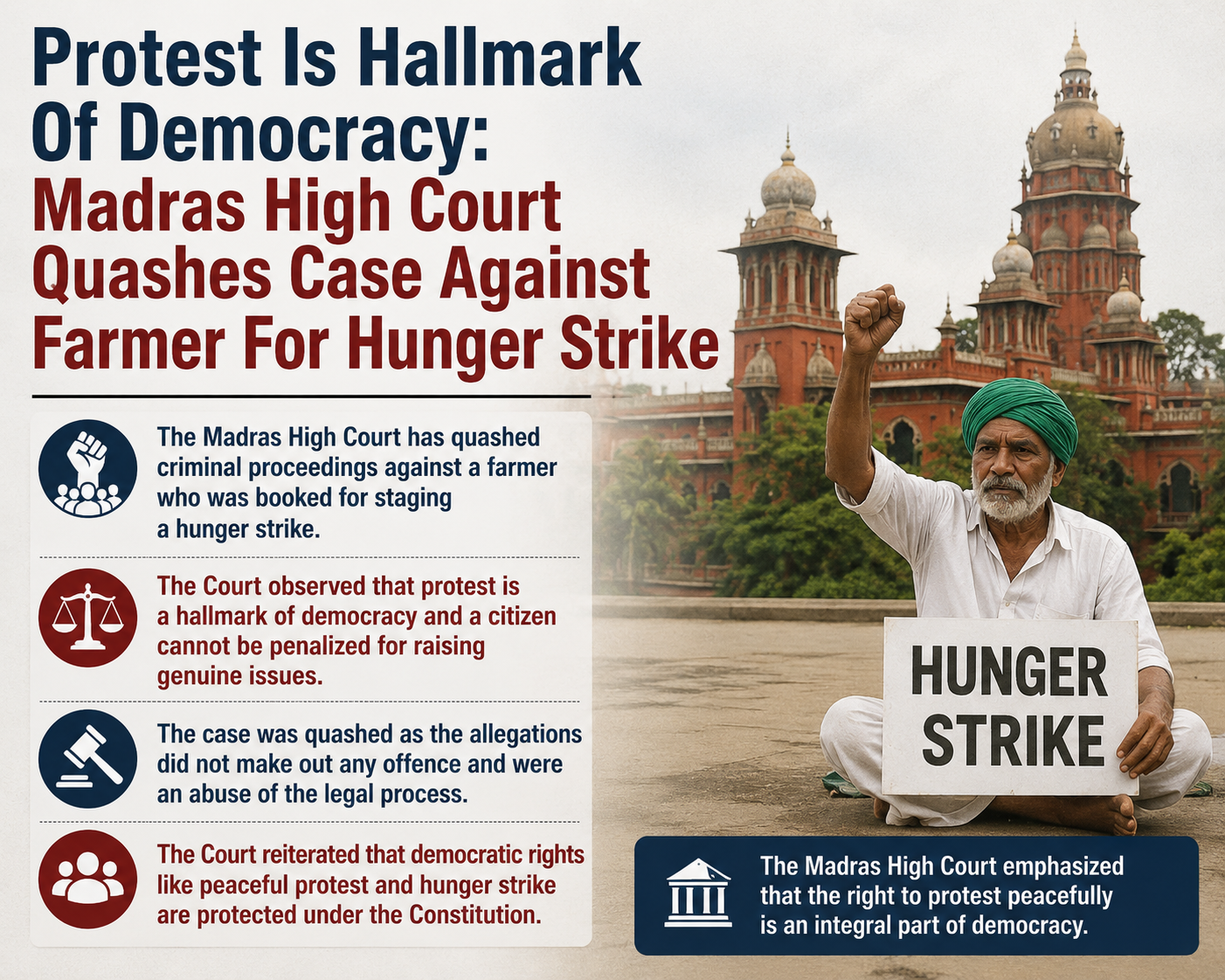
Protest Is Hallmark Of Democracy: Madras High Court Quashes Case Against Farmer For Hunger Strike
📅 18 July 2026
The Madras High Court has quashed criminal proceedings against a farmer who staged a hunger strike, observing that peaceful protest is a hallmark of democracy and cannot be treated as a criminal act merely because it expresses dissent.
The Court held that citizens have a constitutional right to raise genuine grievances through peaceful means, including hunger strikes, as long as public order is not disturbed. It found that the allegations against the farmer did not disclose any cognizable offence and that continuing the prosecution would amount to an abuse of the legal process.
Reaffirming the importance of democratic freedoms, the High Court emphasized that peaceful protests are protected under the Constitution and directed that the criminal case against the farmer be set aside.
← Back to News
The Court held that citizens have a constitutional right to raise genuine grievances through peaceful means, including hunger strikes, as long as public order is not disturbed. It found that the allegations against the farmer did not disclose any cognizable offence and that continuing the prosecution would amount to an abuse of the legal process.
Reaffirming the importance of democratic freedoms, the High Court emphasized that peaceful protests are protected under the Constitution and directed that the criminal case against the farmer be set aside.